
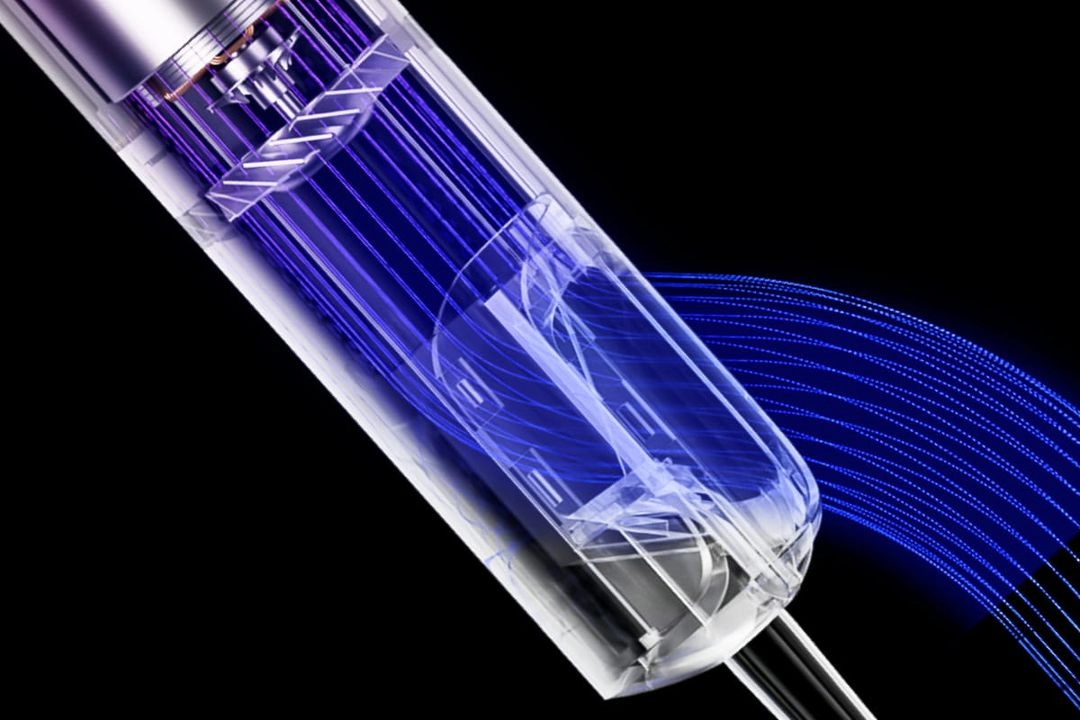
Hair damage from blow-drying is usually blamed on temperature, and the assumption that follows is that a lower setting is automatically safer. That is only partly true. Two dryers running at the same nominal temperature can produce very different amounts of damage, because what damages hair is not the setpoint but the uncontrolled excursions above it, the dwell time in the hot zone, and how unevenly the heat is distributed.
This article looks at the three mechanisms that actually determine hair protection, and how each is engineered.
Why heat damages hair at all
Hair is largely composed of keratin, a protein held in a structured arrangement by hydrogen bonds, salt bonds and disulphide cross-links. Water disrupts the hydrogen bonds — which is exactly why hair can be reshaped when wet — and heat accelerates the disruption and drives off the moisture inside the fibre.
Two damaging effects follow from excessive heat:
- Moisture loss from inside the fibre. Hair with a normal moisture content is elastic. Driven too dry, it becomes brittle, loses tensile strength and loses shine, because surface cuticles lift and no longer lie flat.
- Damage to the cuticle and to the disulphide bonds. At higher temperatures the cuticle edges can crack and the internal bonds that give the fibre its strength can begin to break down. This damage is cumulative and not reversible.
The widely used industry guideline for styling tools — around 180 °C for a straightener — is sometimes misapplied to dryers. It does not transfer, because a dryer heats air, not the hair directly, and the hair surface temperature depends on airflow, distance and dwell time rather than on the setpoint alone. What transfers is the principle: the danger lies in the excess, not in the intent.
Mechanism one: measuring the real air temperature
Most damage attributed to dryers happens because the air is hotter than the user believes. This comes from three sources.
Recycled hot air
When the air inlet is obstructed — pressed against a pillow, a hand, or the side of the head while styling — the motor draws in already-heated air from the housing. The heating element continues to add energy at the same rate, so the outlet temperature climbs well above the setpoint while the display still shows the setting. A protection feature that detects restricted inlet conditions and limits the output is a genuine safety measure, not a marketing feature.
Sensor placement and thermal lag
A control loop is only as good as its sensor. The thermistor or thermocouple must be positioned where it measures the air the user actually receives, close enough to the outlet to be representative but protected from direct radiant heat from the element itself. A sensor placed upstream of the heating element measures the wrong quantity and the loop corrects for the wrong error.
Equally important is the response rate. Heating elements have thermal inertia; when the setpoint changes or the airflow drops, the element's stored heat continues to enter the airstream. The control algorithm has to account for this lag rather than simply reacting to the measured error, or the temperature will overshoot on every adjustment.
Control architecture
Simple dryers use a thermostat plus thermal fuse: a binary on-off element that switches at a fixed temperature. This produces a sawtooth temperature profile with excursions above the intended average. Better designs use proportional control, where the duty cycle of the element is modulated continuously to hold a narrow band around the setpoint. The difference is visible on a temperature trace and audible in the airflow stability.
Mechanism two: getting the heat out of the air path quickly
Regulation is only half the problem; the other half is delivering the regulated air without the element re-heating it on the way out. This is where the air path and the heater element placement interact.
- Heater element geometry. A coiled wire has a large surface area and heats the air efficiently, but it also stores a great deal of heat. A low-thermal-mass element responds faster but may need a longer path to transfer the same energy.
- Distance from element to outlet. The shorter the path, the less the airstream is re-heated after the sensor, and the faster the loop can correct. This is a reason compact high-speed designs with the motor in the handle can regulate temperature more tightly than a long-bodied conventional dryer.
- Mixing. Hot spots downstream of the element occur where the flow is not fully mixed. Static mixers or baffles straighten and blend the airstream so the temperature measured is representative of the temperature delivered.
Mechanism three: keeping the heat away from the scalp
The scalp is more sensitive to temperature than the hair shaft, and the scalp is what the user actually feels. Two design features address it independently of the air temperature setting.
NTC thermostats that sense and modulate
An NTC (negative temperature coefficient) sensor measures the delivered air and feeds the controller, which modulates element power to hold a target temperature. This is the difference between a dryer that merely has a "low heat" setting and one that actively maintains a temperature.
Distance and airflow management
The temperature at the scalp depends on the air temperature at the outlet, the distance, and the airflow rate. Higher airflow at the same outlet temperature means the scalp surface is exposed to hot air for a shorter effective time and the boundary layer is swept away, so the felt temperature is lower. This is why a high-speed dryer with strong airflow can be more comfortable at a given temperature setting than a slower dryer — and why airflow and thermal comfort cannot be specified independently.
What actually protects hair: the control loop as a whole
Putting the mechanisms together, hair protection is delivered by the entire chain rather than by any single feature:
- A sensor that measures the air the user receives, positioned correctly.
- A control algorithm that anticipates thermal lag instead of reacting to it.
- An air path that delivers the regulated air to the outlet without re-heating or hot spots.
- Airflow sufficient to sweep moisture and heat away from the scalp.
- Inlet-obstruction detection to prevent runaway temperature when the user blocks the intake.
A dryer with a precise temperature display but a slow, poorly positioned sensor and a high-thermal-mass element will still damage hair. The opposite configuration — modest setpoint accuracy with a fast loop and uniform delivery — will be markedly gentler in practice.
Specifications worth asking for
Thermal performance is harder to compare than airflow, so the questions are different. Useful requests include:
- Temperature accuracy at the outlet: the tolerance band around the setpoint, not just the setpoint value.
- Control method: proportional or thermostat-based, and the control cycle time.
- Sensor type and location in the air path.
- Presence and behaviour of an inlet-obstruction or over-temperature cut-off, and the temperature at which it acts.
- Time to reach stable operating temperature from cold, and the overshoot during the ramp.
- Temperature uniformity across the outlet, since a hot spot is what damages a section of hair regardless of average temperature.
These are engineering answers, and a supplier that can provide them is describing a product built for controlled heat rather than for a temperature number on the packaging.
Temperature control only works in combination with adequate airflow; for how those two interact, see airflow versus air pressure. For the motor and impeller that make high airflow possible, read inside a high-speed brushless motor. If you are specifying a product for your own market, our customization and OEM/ODM page covers how the process works, and the FAQ addresses the commercial questions.