
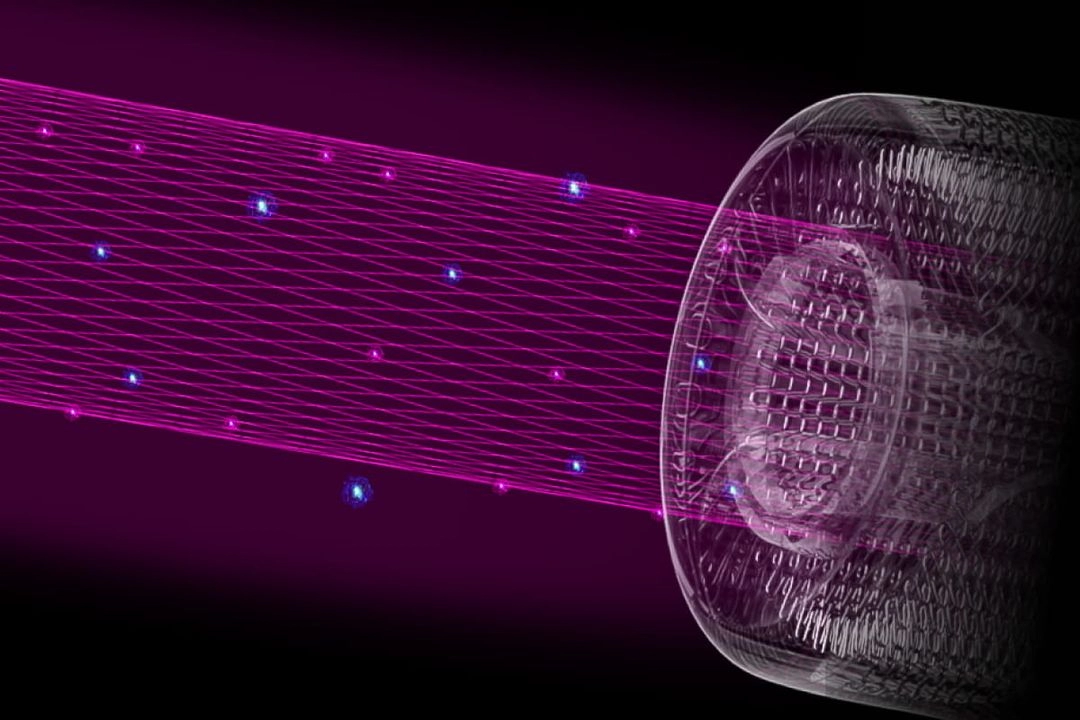
A dryer with a higher airflow rating is not necessarily faster. Anyone who has compared two products with similar cubic-metres-per-hour figures and found one clearly quicker has already run into the reason: airflow is only half the story, and the more influential half is usually the one that is not printed on the box.
This article separates the two quantities, explains how they trade against each other, and shows which specification numbers actually predict performance.
Two different quantities that are constantly confused
Volumetric airflow measures how much air passes a point per unit time — cubic metres per hour, or litres per second. It describes the quantity of the airstream.
Air velocity measures how fast that air is moving — metres per second. It describes the speed of the airstream. The two are related through the cross-sectional area of the outlet:
Velocity = volumetric flow ÷ outlet area
This single relationship explains most of the confusion in the category. A dryer with a large, wide outlet can post an impressive airflow number while delivering a slow, diffuse airstream. A dryer with a compact nozzle can deliver a much higher velocity from the same fan. Neither number is wrong; they simply describe different things.
Why velocity is what actually removes water
Water sits on the hair surface held by surface tension and by capillary action between fibres. Removing it requires either heat to evaporate it or aerodynamic force to shear it off the surface and drive it away.
The aerodynamic force available scales with the square of velocity. Doubling airspeed multiplies the shearing and driving force by roughly four, which is why a high-velocity jet at a compact outlet removes surface water so much more aggressively than a broad, gentle flow of the same volumetric rate. This is the mechanical half of drying, and it does the work without adding heat — which is precisely why it protects the hair.
Velocity also matters because of its reach. A high-velocity jet retains its structure further from the outlet, so it still does useful work at the distance a user actually holds the dryer — typically 15 to 30 cm from the head. A low-velocity flow spreads and decelerates quickly, and by the time it reaches the hair it has lost much of its force.
Why volumetric airflow still matters
Velocity alone is not enough, for two practical reasons.
- Coverage. A very high-velocity but very narrow jet dries a small area extremely fast and leaves the rest of the head untouched. Drying a whole head of hair is a coverage problem as much as a force problem, and coverage scales with volumetric flow.
- Moisture transport. Air that has already absorbed moisture has to be replaced. Sufficient volumetric flow ensures the humid boundary layer around the hair is continuously swept away rather than saturating and stalling evaporation.
The practical consequence is that the best drying performance comes from a design that achieves high velocity and adequate volumetric flow simultaneously — which is exactly what running a small impeller at very high speed makes possible, and what a large slow fan cannot do.
Where the air goes after the impeller
Airflow and velocity at the outlet are the end of a chain that begins inside the housing. The path in between — the air duct — determines how much of the impeller's output survives to the nozzle.
Losses come from several places:
- Turns. Every change of direction costs pressure. A duct that turns the flow through 90° twice loses more than one that turns once, which is one reason motor-in-handle designs require careful internal shaping.
- Sudden area changes. Abrupt expansions and contractions create turbulence and separation. Gradual transitions preserve energy.
- Surface finish and obstructions. Internal ribs, heater element supports and wiring routed through the duct all add drag.
- Leakage. Gaps around the impeller shroud or between housing sections allow flow to bypass the nozzle entirely. This is invisible in the specification but audible as reduced performance at the outlet.
A well-designed air duct is why two products with the same motor and impeller can differ measurably in measured outlet velocity. When comparing suppliers, asking for the internal air path design is a legitimate and revealing question.
How nozzle design changes everything downstream
Attachments are not accessories; they are aerodynamic components that re-shape the airstream, and each is optimised for a different job.
- Concentrator nozzles reduce outlet area to raise velocity for precise styling and root lift. They trade coverage for force.
- Smoothing nozzles use internal vanes to straighten the flow and reduce turbulence, producing a wider, more uniform airstream that aligns cuticles rather than blasting them.
- Diffusers deliberately spread and slow the flow to reach the roots and add volume without disturbing curl pattern.
Because the outlet area changes, the same dryer can present very different velocity figures with different attachments. A specification sheet that quotes airflow without stating which nozzle is fitted is impossible to compare against a competitor.
Reading a specification sheet without being misled
Five rules cover most of the traps:
- Insist on the measurement distance. Velocity should be quoted at a stated distance from the outlet, commonly 30 cm. An outlet-face figure is not comparable to a working-distance figure.
- Ask for airflow and velocity together. Either one alone can be flattered by design choices.
- Confirm which attachment was fitted. Compare like with like.
- Check the test standard. International Electrotechnical Commission methods for airflow and sound measurement exist; a supplier citing a standard is easier to compare against.
- Treat "wind power" or similar unqualified marketing terms as noise. They correspond to no defined measurement.
The design balance is the product
Every high-speed dryer sits somewhere on a spectrum between maximum force and maximum coverage, and where it sits determines what it is good at. A dryer tuned for maximum velocity is excellent for precision styling and fastest possible drying of a small section, but requires more user movement to cover the whole head. A dryer tuned for broad volumetric flow is more comfortable for general drying and for thick or long hair, but gives up some of the aggressive surface-water removal.
For a brand owner, this is a positioning decision, not just an engineering one: the airflow balance should match the market the product is sold into. Discussing it explicitly with your manufacturing partner is the difference between a product that reviews well and one that gets returned.
The airflow balance depends entirely on the motor and impeller behind it. For how those work, see inside a high-speed brushless motor. To understand the other half of drying performance, read intelligent temperature control and hair protection. If you are comparing specifications from different suppliers, our purchasing guide explains how to normalise airflow and velocity figures across quotations. For how the airflow balance is tuned to your market during development, see customization and OEM/ODM.