
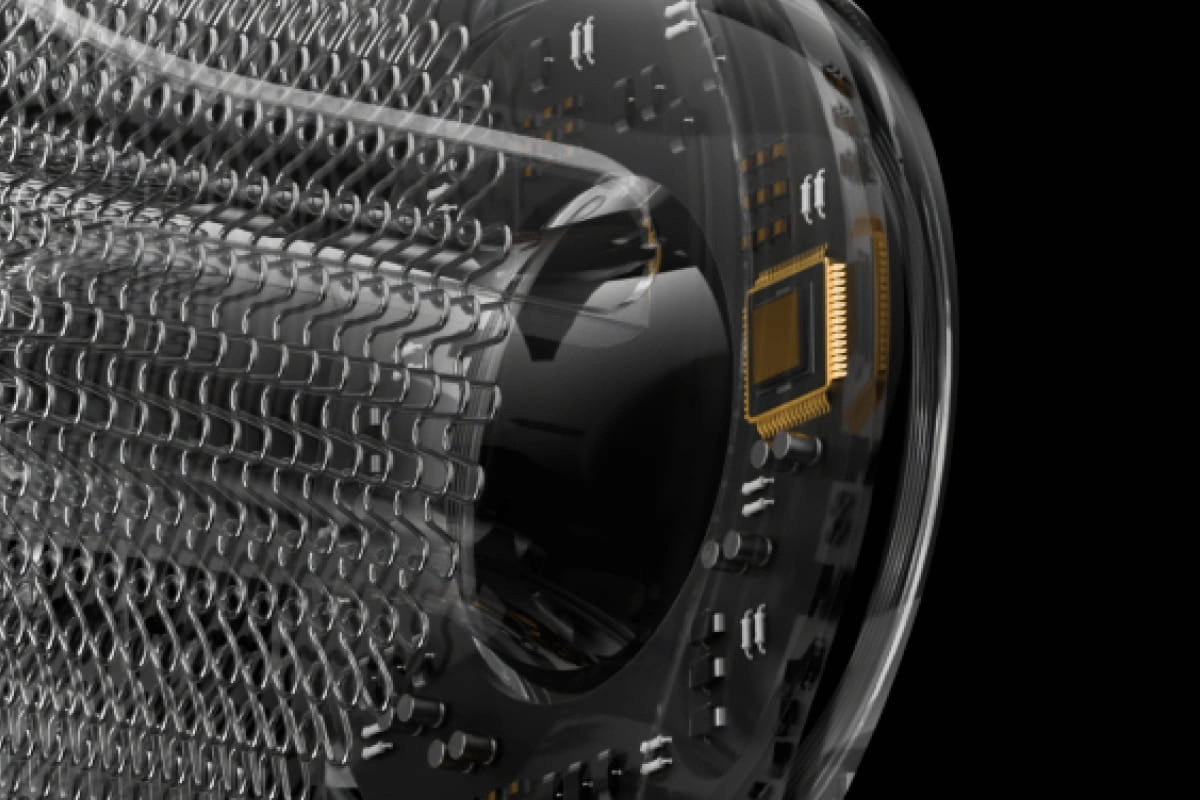
Pick up a conventional hair dryer and a high-speed one and the weight difference is the first clue. The second is the sound: one rumbles at a low frequency, the other produces a thinner, higher-pitched tone. Both differences come from the same source. The motor inside has been replaced by a completely different machine, running at roughly five times the speed in a fraction of the volume.
Here is what is actually inside, and what each component contributes to the performance you feel.
Conventional motors: a large fan turned slowly
The traditional hair dryer uses a universal (brushed) AC motor. It spins at roughly 20,000 to 30,000 RPM, is comparatively heavy, and drives a large-diameter axial fan that looks like a small propeller.
Because the fan is large and slow, it moves a lot of air per revolution but at low velocity. It also relies on carbon brushes rubbing against a commutator to switch the current, which produces sparks, electrical noise, ozone, and brush wear that gradually reduces performance over the product's life. The motor is cheap and robust, which is why it dominated the category for decades.
What replaces it: a brushless DC motor running an order of magnitude faster
A high-speed appliance motor is a brushless DC (BLDC) design. It inverts the geometry: a small rotor carrying permanent magnets spins inside a stator wound with copper coils, and the coils are switched electronically rather than mechanically. Typical operating speeds are in the range of 100,000 to 110,000 RPM.
Why the speed matters more than the size
Two physical effects follow from running a small impeller very fast:
- Velocity, not just volume. A small impeller at very high speed produces a high-velocity jet. That velocity is what strips water from the hair surface, and it is the single biggest reason a high-speed dryer feels dramatically faster even when its airflow rating in cubic metres per hour is not enormously higher than a conventional unit.
- Weight and balance. A motor with a rotor of a few centimetres can deliver the power of a much larger assembly. This is what allows the motor to be placed in the handle rather than the head, which changes the balance of the whole product and makes it usable for longer without arm fatigue.
The trade-off nobody mentions
High rotational speed means high-frequency sound. A 110,000 RPM rotor produces a fundamental tone in the region of 1.8 kHz, and its harmonics sit right in the most sensitive part of human hearing. This is why a high-speed dryer can be measurably quieter in overall sound pressure level while still sounding more piercing than a low-frequency conventional unit. Reducing that tone is a genuine engineering problem, addressed through impeller blade count and spacing, motor mounting and damping, and the acoustic design of the air path.
The impeller: where airflow is actually made
The impeller is the aerodynamic heart of the machine and is usually a mixed-flow or centrifugal design with a high blade count, machined or moulded to tight tolerance and dynamically balanced.
Three parameters dominate its behaviour:
- Blade count and geometry. More blades at the same diameter generally increase pressure capability; blade shape and exit angle determine how efficiently that pressure is converted into velocity.
- Tip clearance. The gap between the impeller edge and its housing is a direct leakage path. At 110,000 RPM even a fraction of a millimetre is significant, which is why the impeller and shroud are made as a matched, tightly toleranced pair.
- Balance. An impeller that is not dynamically balanced will vibrate and transmit that vibration to the handle, and it will wear its bearings prematurely. Balancing quality is what separates a durable high-speed dryer from one that becomes noisy after a few months.
Bearings: the component that decides service life
At these speeds, bearings are a wear item and a design constraint. Most designs use precision ball bearings, sometimes with ceramic balls or with an air-bearing arrangement in premium products. The practical question for a buyer is not which type is used, but what the rated life is at the operating speed, and how the design handles the axial load from the impeller and any thrust imbalance.
This matters because bearing wear is the most common failure mode of a high-speed dryer in the field, and it usually appears as increased noise before it appears as a functional failure.
The control electronics: where smoothness and silence come from
A BLDC motor cannot run without a driver, and the quality of that driver is as important as the motor itself.
- Commutating the coils. The driver must know the rotor position to switch the coils at the right instant. This is done either with Hall-effect sensors or, more commonly in compact designs, sensorless estimation of the back-EMF waveform.
- Field-oriented control. FOC controls the motor by resolving the current into torque-producing and flux-producing components, allowing smooth torque, low vibration and efficient operation across the speed range. A poorly tuned or absent FOC implementation is a common reason two dryers with the same motor feel different in the hand.
- Ramp profiles. How the motor accelerates and decelerates determines the felt quality of start-up and the mechanical stress on the bearings. Aggressive ramps are cheaper to implement and harder on the hardware.
What to look for on a specification sheet
Because the internals are not visible in the finished product, the specification sheet is the only negotiating surface. The numbers that carry real information are:
- Motor type and rated speed, stated as BLDC with an RPM figure rather than as a vague claim of "high speed".
- Air velocity at a defined distance, typically measured in metres per second at 30 cm from the outlet. This is far more meaningful than an outlet-only figure.
- Airflow in cubic metres per hour or litres per second, ideally alongside the velocity figure, since the two trade against each other.
- Sound pressure level in dB(A) with the measurement distance stated.
- Bearing type and rated life, or at minimum the expected operating hours.
- Motor driver details: whether field-oriented control is used, and what the temperature and speed control loop looks like.
A supplier who can answer these questions from a datasheet, rather than in general language, is telling you something useful about how the product was engineered.
Once you understand the motor, the next question is how its output is converted into drying performance. That is covered in our article on airflow versus air pressure. For how the air is heated and controlled, see heat control and hair protection. If you are evaluating suppliers rather than designing a product, start with the purchasing guide.